What is padahastasana (feet touching by hand pose)?
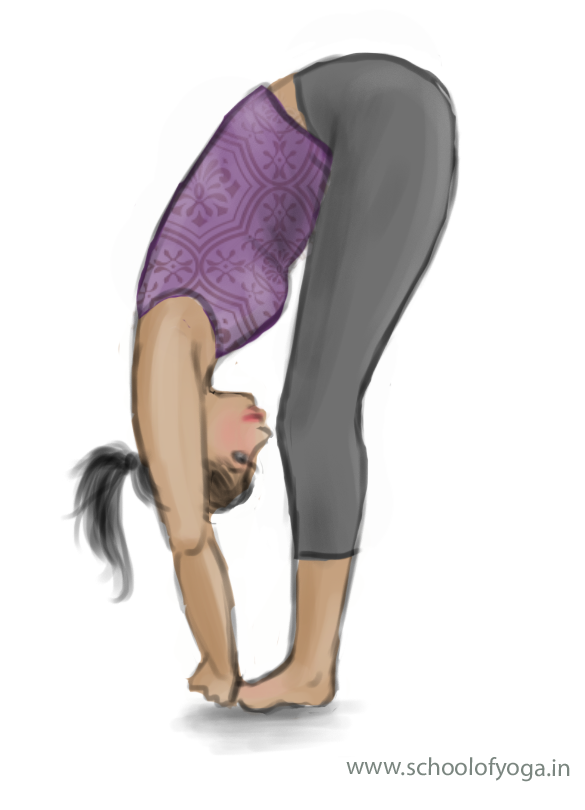
The padahastasana (pada = feet and hasta = hands), also known as the feet touching by hand pose, is a fundamental forward bend pose. This is a full-body stretch that helps improve flexibility.
What is the technique to practice padahastasana pose?
- Sthithi (starting) position: Firstly, stand erect with feet and knees straight and together. Keep your hands at your sides.
- Next, breathe in and lift your hands straight above your head.
- Then, breathing out, bend forward to touch your toes without bending your knees.
- Relaxing the lower back, slowly suck the abdomen inwards and pull the torso forward so that your face touches your knees.
- Hold for 3 to 10 counts.
- Next, breathing in, return to an erect position with your hands stretched above your head.
- Breathe out and drop your hands to the sides.
- The recommended drishti (gaze) is nasikagra (middle of the brow gaze), at the final position or svadhishthana cakra.
What are the benefits of padahastasana yoga pose?
- The action of bending forward certainly brings suppleness to every posterior muscle in the upper and lower back, and also restores strength to the cartilages and muscles on the lower back.
- This action of bending forward also stretches and tones the hamstrings.
- This is a great aerobic exercise when done rapidly.
What are the contraindications of the feet touching by hand pose ?
- People with back problems and circulatory disorders should not attempt this asana without first consulting a physician.
- People with lower back problems must perform this asana only under the supervision of a physician.
- Do not perform this asana during menstruation or pregnancy.
Some noteworthy points on the feet touching by hand pose :
Internal Links: Dharma (conditioning), Stress and Situational Awareness, Prana, Asana overview 1, Asana Overview 2, Asana Focus or gazing, Pranayama
External Links: Prana, Chakra, Pancha Tattva, Pancha Prana, Pancha Kosha, Nadi.
- People with cardiac ailments should perform this exercise slowly, due to the aerobic nature of this asana.