What is halasana (plow pose)?
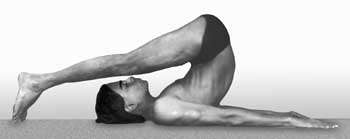
The plow pose or halasana is an advanced asana. Here, the practitioner takes both the legs over the face and stretches as far back as possible. Importantly, since there are many chances of mistakes, this asana should be learned under supervision.
How to do halasana? (Should be learned under supervision)
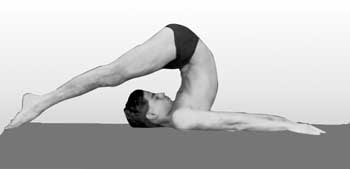
- Sthithi (starting) position: First, lie on the back, hands to the side. Then, breathe in.
- Next, breathe out, and using your back and leg muscles as support, lift both your legs off the floor, over the face, to the rear of the head.
- Slowly, taking care not to jerk the neck, begin to stretch the legs as far back as possible.
- Importantly, ensure that there is equality in the stretch of your legs, such that both legs are straight and there is no distortion in the balance between the legs when stretching. Also, ensure that the shoulders are balanced evenly on the floor.
- Initially, the legs will bend and not stretch out straight. However, over time and with practice, the final posture will be reached.
- At this point, the shoulder will support the back and lock with the neck.
- Furthermore, the degree to which the legs are straightened and stretched away from the face indicates the expertise in this asana.
- Importantly, maintain shallow breathing if unable to sustain a “breathing out” state.
- Also, hold for 3 to 10 counts.
- Slowly, release the pressure on the back and bring your feet closer to the face.
- Breathing in, lift the legs and bring them back to the ground. Straighten the body.
- Relax, and breathe deeply. Repeat once if required.
- The yoga drishti (gaze) recommended is focus on the neck-lock in the vishuddhi-chakra.
What are the benefits of halasana yoga pose?
- First, this exercise is excellent for toning up the nerves and muscles of the entire spine – neck, shoulders, upper and lower back, lower thigh muscles and hamstrings.
- Importantly, this asana energises the cardio vascular system to a greater extent.
- Lastly, in the final pose, where the head is held in a chin lock, the carotid artery is squeezed, thereby diverting blood to the thyroid. This improves the functioning of this critical component of the endocrine system.
What are the possible halasana contraindications?
- Firstly, if you have any form of back ache, do not attempt this asana without adequate supervision and support from a professional.
- Importantly, people with cardiac problems, lower back problems and circulatory disorders should not attempt the final position.
- Also, do not perform this asana if you have cervical spondylosis, hernia or arthritis.
- Lastly, do not practice this asana during menstruation or pregnancy.
Some noteworthy points on the plow pose :
Internal Links: Dharma (conditioning), Stress and Situational Awareness, Prana, Asana sequence, Asana schedule, Asana Focus or gazing, Pranayama, Hatha Yoga Pradeepika
External Links: Prana, Chakra, Pancha Tattva, Pancha Prana, Pancha Kosha, Nadi,
- While this exercise is very good for energizing the endocrine system, those with cervical or lumbar spondylosis should avoid this exercise completely.
- Initially, some may be tempted to use their hands to support the back when lifting and returning the legs to their original position. Whilst this is acceptable when one is learning the exercise, over time one should try to lift both the legs and take them over the face to the rear without support, as this strengthens the muscles of the abdomen and lower back.
- Importantly, using the back to lift the legs also results in an increased sense of balance between the left and right halves of the torso. However, one should be careful and not jerk or move too rapidly.