Acknowledgement – School of Yoga is deeply grateful to Dr. H.S. Ram Mohan for sharing his work on Agni, allowing us to make changes and to publish it on this site.
Read about the origin of Agni and the Fire God’s importance to Bharat (India) at this link.
What is the origin of Agni ?
Importantly, there are many theories about the origin of Agni, the God of Fire.
Some trace the origin of Agni to Indo-European mythologies, while others trace it to mythologies within the Indian tradition.
In the former category, Agni is one of a bird-like being that carries or brings fire from the Gods to mankind, where the bird returns every day with sacrificial offerings for the Gods, from the earth.
The earliest layers of the Vedic texts of Hinduism, such as Kathaka Samhita and Maitrayani Samhita state that the universe began with nothing, neither night nor day existed, what existed was just Prajapati (Brahman).
The origin of Agni was from the forehead of Prajapati, and with the creation of Agni came light. Thereafter, day and night were created. Importantly, these mythologies develop into more complex stories about the origin of Agni in the later layers of Vedic texts, such as Taittiriya Brahmana and Shatapatha Brahmana.
The origin of Agni : How was he positioned in the pantheon of deities?
Originally, Agni was conceptualized as part of the holy triad, where he ruled the Earth, while his twin Indra ruled the atmosphere as the God of storm, rain and war, and Surya ruled the sky and heavens.
Importantly, in the Vedic pantheon, Agni is placed just after Indra. Additionally, Agni is prominent in the hymns of the Vedas and particularly the Brahmanas. Also, in the Rigveda there are over 200 hymns that praise Agni. In fact, his name or synonyms appear in nearly a third of 1,028 hymns in the Rigveda.
Furthermore, the hymns in these ancient Vedic texts refer to Agni with numerous epithets and synonyms, such as Jatavedas (he who knows all generations), Vaishvanara (relating to all humans), Tanunapat (son of himself, self-made), Narasamsa (who embodies men’s praise), Tripatsya (with three dwellings), and many others.
Interestingly, in the Puranas, Agni is the eldest son of Brahma. Additionally, in the Visnu Purana, Agni, called Abhimani is said to have sprung from the mouth of the Virat purusha, the Cosmic Man or Iswara. In another version, Agni emerged from the ritual fire produced by the wife of Dharma (eternal law) named Vasubharya (literally, “daughter of Light”). So, here Agni is depicted as a female.
(All reference here from Wikipedia)
The origin of Agni: Family and creation
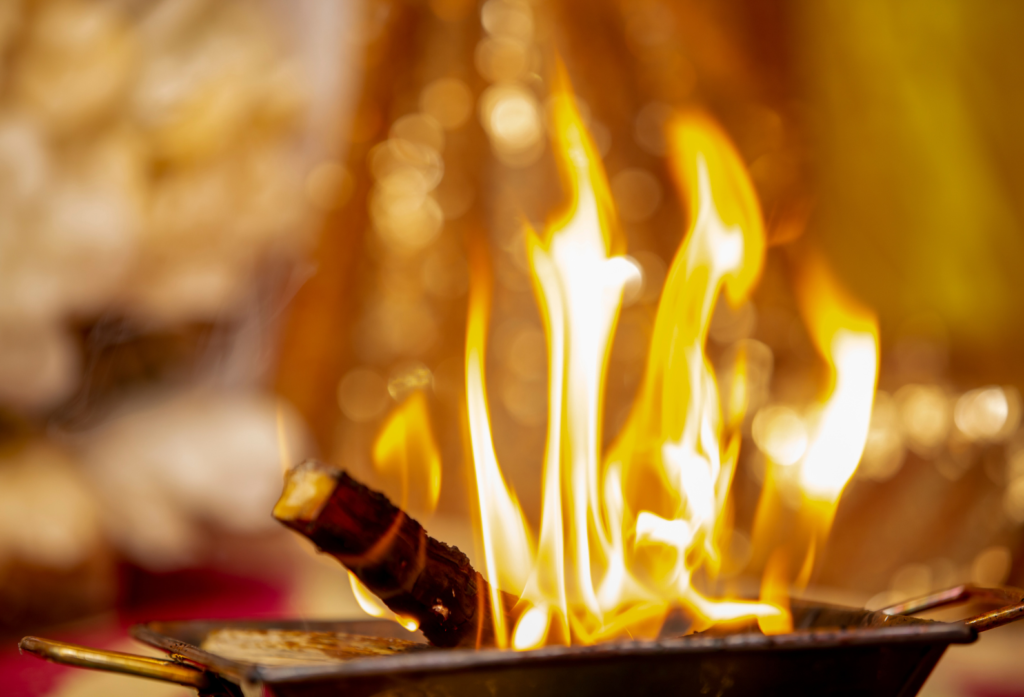
The Vedas describe the parents of Agni as two kindling fire sticks (arani), whose loving action creates him. Just born, he is poetically presented as a tender baby, who needs loving attention, lest he vanishes. With care, he sparks and smokes, then flames and grows stronger than his parents, finally so strong that he devours what created him. In some texts, Medha (intelligence) is Agni‘‘s sister.
In fact, the Vedas declare: “Put it down supinely stretched, you attentive (priest). When impregnated she gave birth to the male (Agni)”.
Agni as a householder
According to the Puranic mythology, Agni married Svaha (invocational offering) and fathered three sons – Pavaka (purifier), Pavamana (purifying) and Shuchi (purity). From these sons, he had forty-five grandchildren which are symbolic names of different aspects of a fire.
Agni ‘s wife Svaha
Svaha is Agni’s wife. Her name is pronounced when offerings such as ghee are poured into the fire during homa (fire sacrifice). However, like many names in Hindu traditions, the name Svaha embeds symbolic meanings, through its relationship with the Vedic word Svadha found in the hymns of the Rigveda. In fact, the term Svadha refers to “one’s own particular nature or inclination”. It can also mean, in a secondary sense, “a customary pleasure or enjoyment, a refreshment that nourishes”. Svaha is also found in the hymns of the Vedic literature, in the sense of “welcome, praise to you”.
This salutation is a remembrance of Agni, as an aspect of that which is “the source of all beings”. As a Goddess and wife of Agni, Svaha represents the manifestation of Agni.
Other relationships
The Mahabharata also mentions that when Agni was residing at Mahishmati he fell in love with the daughter of King Nila. In the guise of a Brahmana, he asked for the hand of the princess, but the king refused and was about to punish him. Agni revealed his true form and flamed up in wrath. The frightened king apologized and bestowed his daughter on Agni. In return, Agni promised protection of the city during any invasion.
Furthermore, in the text Devi Mahatmya of Saktam, and in Hindu mythologies, Svaha is the daughter of Daksha. Also, the son born to Agni and Svaha grows to become God Skanda – the God of war.
However, the more accepted Kaumaram tradition refers to Skanda as Kumara, the son of Siva.
The origin of Agni : What is Agni’s relationship with other deities (devas) ?
Agni is identified with same characteristics, equivalent personality with many major and minor Gods in different layers of the Vedic literature. Some of the Gods whom Agni is identified with, are: Prajapathi (Shatapatha Brahmana), Varuna and Mitra, Indra, Rudra ( Rig Veda), Vayu and Soma ( Vedas), Gayatri (Aitareya Brahmana), Vac (Goddess of speech) and Prana (motility) in Jaiminiya Brahmana.
The origin of Agni : How is Agni represented in Bharat ?
Just as we have different theories on the origin of Agni, the iconography of Agni also varies by region. Importantly, the design guidelines and specifications of his iconography are described in the Hindu Agama texts.
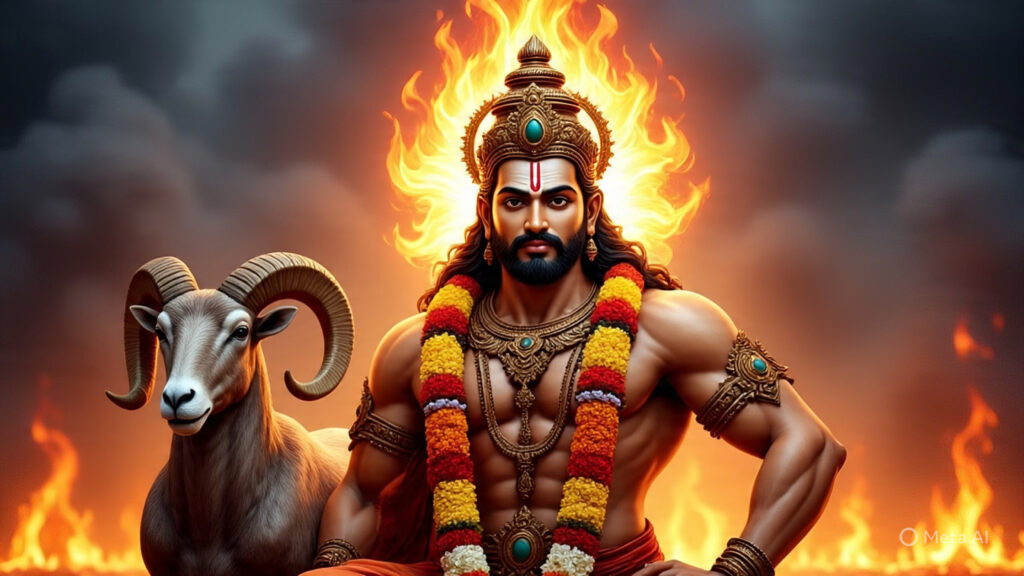
Here, he is shown with one to three heads, two to four arms, is typically red-complexioned or smoky-grey complexioned, standing next to or riding a ram, with a characteristic dramatic halo of flames leaping upwards from his crown. Also, he is shown as a strong looking man, sometimes bearded, with a large belly because he eats everything offered into his flames, with golden brown hair, eyes and moustache to match the colour of fire.
Agni holds a rosary in one hand to symbolize his prayer-related role, and a sphere in another hand in eastern states of India. Sometimes, in other regions of India, his four arms hold an axe, torch, spoon (or fan) and a flaming spear (or rosary). Significantly, seven rays of light or flames emit from his body, and so he is called saptajihva, “the one having seven tongues”, to symbolize the many ways in which he consumes the sacrificial offerings.
Occasionally, Agni ‘s iconography is shown in rohitasva form, which has no ram as his vehicle (vahana), but where he is pulled in a chariot with seven red horses, signifying that all work is thermodynamics. Also, the number seven symbolizes his reach in all seven mythical continents in ancient Hindu cosmology, or the colours of a rainbow in his form as the sun.
Sometimes, texts refer to Agni as having two wives/shaktis, namely Svaha and Svadha, who represent the oblations for the deva/ deities and pitru/ ancestors respectively. Thus mantras ending in either of these two words specifically refer to the object of the offering being either to God or ancestors, i.e. om agnaye svaha or om pitrbhyo svadha are common uses.
The origin of Agni : Fire as one of the primordial elements (panchabhuta)
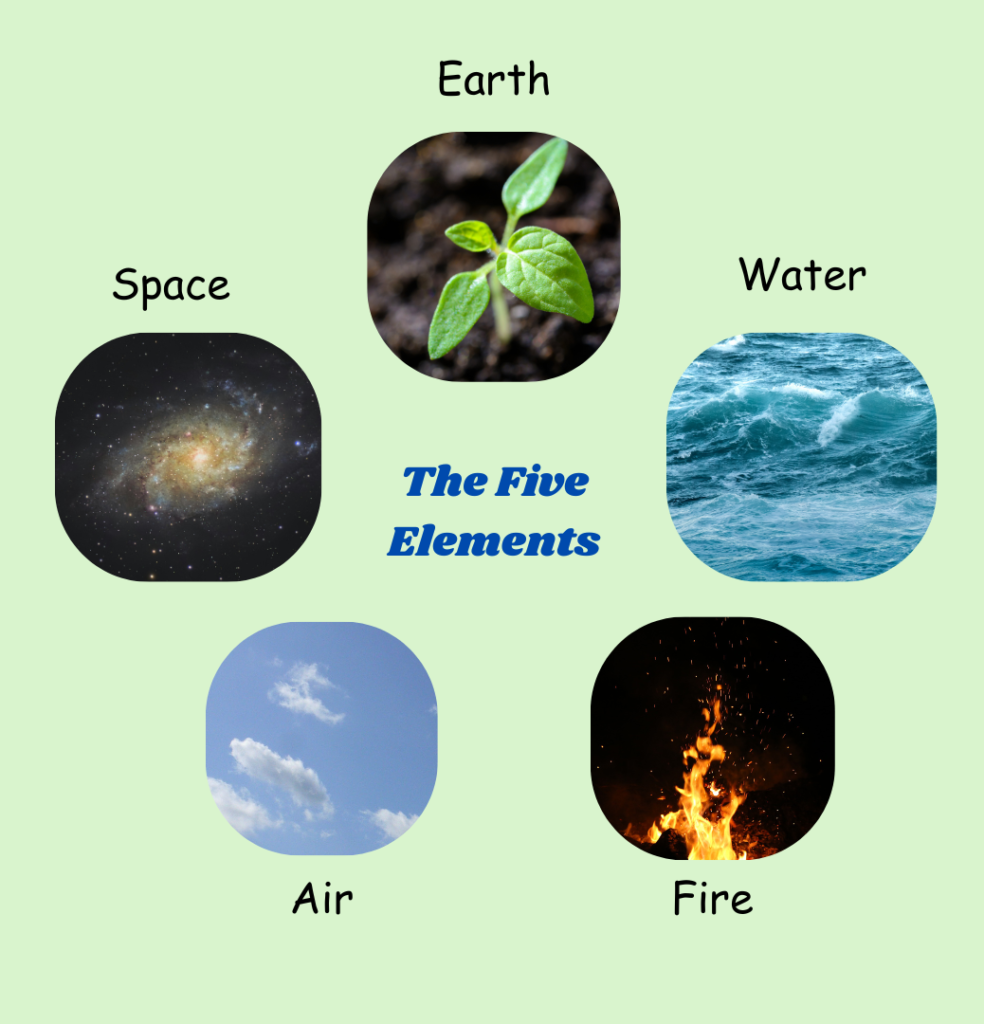
Importantly, Agni is one of the panchabhuta along with earth (prithvi), water (ap), air (vayu), and space (akasha).
Furthermore, Agni is a digpala (protector of direction) devata who rules the south-eastern direction. Importantly, digpalas are devatas who rule the directions of karma and their wives are the givers of fruits of these paths or directions. Here, he is called agnikona, as a reference to one among the ten directions.
Therefore Agni has a very central position in ensuring the fruits of karma.