

What is karma ?
Karma has generally been defined as the principle of cause and effect. While this is correct, it is not complete.
Then, what is karma?
- When we like something, we bring it close to ourselves.
- Conversely, when we dislike something, we push it away.
The action of bringing close or pushing away is called karma.
Since this principle is existential, karma can be considered as the governing principle of all bonds and relationships; covering all sentient, non-sentient, animate and inanimate entities.
How does karma occur?
- We constantly transact with our environment.
- As a result, the feedback we receive from our environment gives us confirmation of existence.
- This aspect which evaluates our existence or our sense of self-worth is called “asmita” in Sanskrit.
- The “sense of self-worth” (asmita) gets its values from our conditioning (dharma).
- Conditioning (dharma) is evolved by our home, parents, school, society, friends, and environment.
- When the interaction with the environment is positive, our “sense of self-worth” (asmita) experiences an expansion, resulting in like/ motivation/ attraction (raga), etc.
- Similarly, when there is a low level or absence of interaction, the “sense of self-worth” (asmita) experiences contraction, resulting in dislike/ repulsion (dvesha), anxiety, distress, or fear.
- Consequently, when we experience attraction (raga), we pull the object closer. When we experience repulsion (dvesha), we try to push the object away.
- This is the principle of action or karma in Sanskrit.
How is debt (rna) related to karma ?
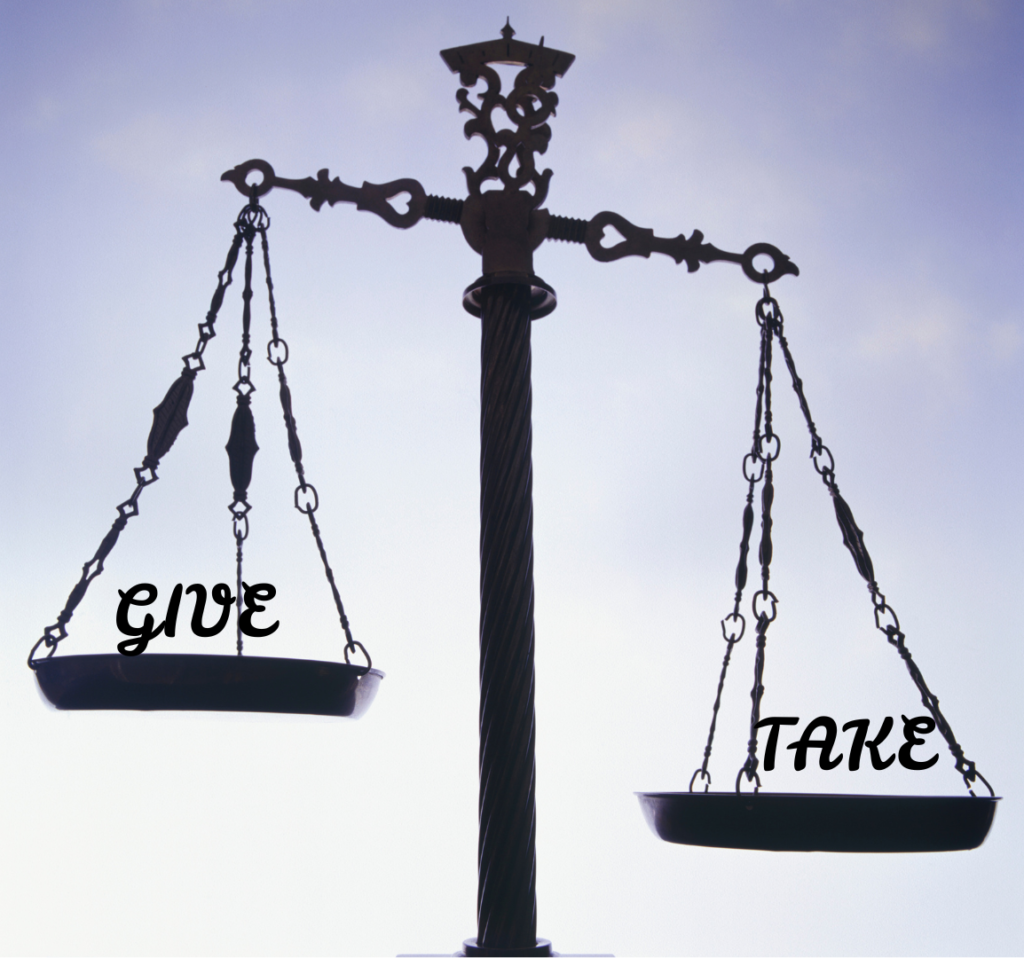
- Karma or action is the foundation of change, hence it is the cause as well as outcome of all situations.
- We know that all situations are driven by relationships / bonds.
- All relationships are governed by transactions, every transaction results in like or dislike because its very rare that we are perfectly neutral in any situation.
- This like-dislike response results in a give and take outcome between the two entities.
- Consequently, like-dislike/ give-take results in movement of one relative to the other, resulting in karma or action.
- However, since transactions are rarely equal, one of the participants will give or get more.
- This causes the participant who takes more to become a debtor and one who gives more to be a creditor.
- But this debt, like any debt, needs to be repaid; if not in this life, in a rebirth.
- This is the basis of the ancient concept of cycle of birth and death (samsara).
Importantly, this give and take need not be material; it could be ideas, feelings, opinions etc. or a mix of these. So, the generation and repayment of debt can take many forms.
How does karma work? What is the difference between good and bad karma ?
Thanks to Shri. P. E. Subramanian for asking the difference between good and bad karma.
- By its very nature, karma is inert. It has no feelings or sentiment. These sentiments are assigned by us through our expectations. Importantly, how do we assign these sentiments?
- Firstly, our sense of right-wrong, good-bad is developed from the moment we are born due to the conditioning through our DNA, parents, school and society.
- Secondly, these values are developed in society for proper functioning and order, and become the accepted norms which everyone conforms to.
- As a result, we conform to two different frames of references. First is to conform to our own sense of values, and second is to conform to the rules set by society/ community/ religion and country.
- In any transaction, when the stimulus or feedback is in conformance with our sense of dharma, we like the person and offer good-vibes which becomes good karma or ashirvada to the other person, and the outcome will be credit to that person and debt to you.
- Conversely, if the transaction results in pain, we will experience bad karma or abhishapa and this will translate as debt to us from the other person.
Example – in any conflict, each side will label the other person as the aggressor. However, the conflict by itself is inert, the bullet doesn’t care who it kills and the combatants are all strangers killing each other.
However, if one was to get their experiences, the combatants will have experiences which will be different from those who have been wounded, or lost a loved one or suffered in some way, and this will be very different from those sitting far away in friendly, unfriendly, or neutral countries. All generate action, but the impact is different. This is why Shri Krishna says that karma is subtle and cannot be fathomed.
What are the different types of bonds and karma ?
- All bonds come out of transactions. When we transact, we relate and this leads to the generation of a bond.
- So, any transaction where the give and take are equal, or where no one is counting give and take, is called samabandhana (equal bond). Mostly, this is between married couples where give and take is not measured. So, in India, the in-laws are called sambandhi or samdi (those of equal bond).
- First, all other bonds create debt and the bond created by debt is called rnanubandhana (bond of debt).
- Next, all debt accrued to or by us in our current situation is called agami-karma (current debt generation).
- Thirdly, the overall aggregation of our debit or credit is called sanchita-karma (overall karma consolidation).
- Also, the debt that comes for repayment is called prarabdha-karma (debt reconciliation). This defines our current existence – who our parents, siblings, friends, partners and children will be, where we will be born, which school we will go to, where we will work etc.
- Finally, karma which impacts everyone such as weather, climate, pandemic or war is called samashti-karma (equal-for-all debt reconciliation).
Explaining with a hypothetical situation:
It is very late in the evening. You are driving home. You are tired. Suddenly, you realize that a car is following you very closely. The driver is a teenager, honking continuously and driving in a very offensive manner. There is no room on the street for him to overtake you and you are getting irritated. You hope that the kid will stop, but it gets worse and you suddenly decide to take the kid to task. So, you stop your car and step out.
- What is your emotional state at this point?
- How is your energy level changing?
- What is your opinion of the other driver?
You stride across to the other car which has stopped some distance behind you. There are two people in the car. You go to the driver’s side and notice that it is a young girl and she seems scared. She tells you that she is just learning to drive, and that the person next to her is her father who fell unconscious when they were having dinner. Furthermore, she somehow managed to get him into the car and is now trying to get him to hospital.
- What is your state at this point?
- How is your energy level changing?
- What is your opinion of the other driver?
- How have you changed?
Click here to read the next article on sanatana-dharma
Some points to ponder :
Internal Tags: Self Awareness or Asmita, Karma Yoga (Bhagawat Gita – chapter 3)
External Tags: vasana (karmic image), purva-mimamsa, nitya-karma, brahma-yajna,
- Does experience change when we “sleep over” a situation? Why?
- Is there experience when we are doing nothing or not react?
- Why is environmental degradation a karma of nature?
- Does nature perform action or karma? How?
- Can inanimate objects increase/ decrease energy in others? Can a car increase energy in you? Does the attachment or aversion you have to your car or cat result in karma?
- What are the ways in which we can increase energy in ourselves & others?
- Can we perform actions with complete awareness and reduce karmic load or debt?
- What is the relationship between karma & accountability?
- Explore the subtleties in the relationship between karma & Self?


Namaste immortal soul. Thank you for this clear explanation of Karma.
Thank you. Please read our updates also.
Very interesting explanation in a different perspective. But how do we explain the concept of good karma or bad karma?
Thanks you for your comments, I am adding this as a section in the blog.
Let us look at the question from first principles. Karma is action, so there is a giver and a receiver. When the giver and receiver are individuals, then obviously, for each of us, if we get something we like, we will experience good karma or āśīrvāda and the outcome will be credit. If the transaction results in pain, we will experience bad karma or abhīśāpa and the outcome will be debt.
However, if the transaction is between us and an entity like society, then obviously, if we follow the rules or dharma, it is good karma and if we break them, we will experience bad karma.
I think good karma is one which results in kārmic credits for us and bad karma is one where we end up in kārmic debt. Śrī Kṛṣṇa himself says that we will get the outcome that is commensurate with our ability to remove ahaṅkāra, so when we act with dispassion (vairāgyam), then bad karma dissipates.