
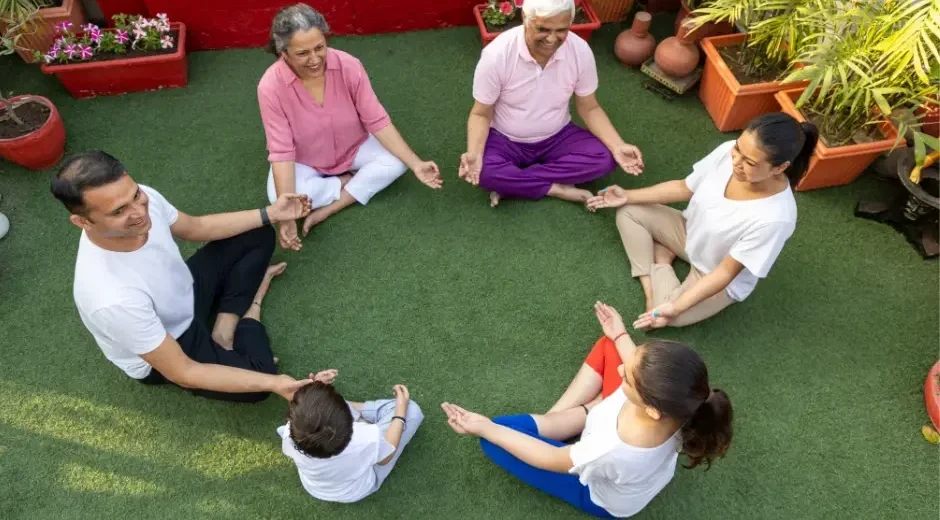
Introduction to āsanas, fitness and health.
All of us aspire to be healthy, and being healthy is our birthright. It only requires common sense, an understanding of the body, and also the willingness to change and be disciplined. Let us understand how āsanas go a long way in enriching our health, with just discipline and regular practice.
In fact, though all of us know this, we get distracted by the push and pulls of conflicting priorities. As a result, we neglect our bodies and fall prey to illness.
What we fail to realise is that good health is not only our right, but also our responsibility.
So, how do we become healthy through āsanas?
Firstly, it’s important that we realise that we are responsible for ourselves, and our actions determine the quality of our lives.
Second, we must take some time out to look after ourselves, no matter how hard it may seem. This may mean sacrificing something else, but so long as it is not critical to our health, such as good sleep and food, the sacrifice will yield benefits throughout our life.
Importantly, the good thing about āsana is that the benefits will be visible from day#1.
Lastly, discipline is vital because, without it, we cannot manage change in a systematic manner.
About Schoolofyoga.in.
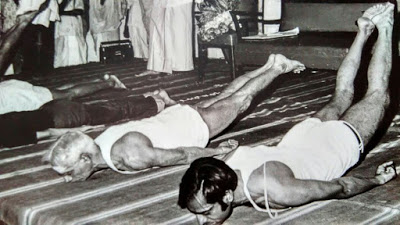
This site follows the Yogacharya Sundaram school of yoga āsana routines for health, fitness and therapy. Yogacharya Sundaram, who started teaching āsana for universal health and fitness in Bangalore, India, developed this successful format around 1921. Incidentally, Yogacharya Sundaram is one of modern Yoga’s oldest teachers and therapists.
The exercise routines focus on maximising the effect on the relevant portion(s) of the body at a time. They are holistic and thus cover all parts of the body.
What are āsanas?
Patanjali Yoga Sutra defines āsana as स्थिरसुखमासनम् ॥४६॥ which can be translated as “āsanam (seat or pose) is that which is static, steady, firm (sthiram) and comfortable (sukham).
In real terms, this means that when practicing āsana, the practitioner should stay close to the state where his body does not experience any stress, a state called homeostasis. Incidentally, homeostasis is a psychosomatic state where the body is in physical and also psychological balance and equilibrium.
Therefore, āsana is a static exercise where the body movement is minimal and the focus is on holding the pose to maximise impact on a specific area of the body.
How do āsanas bring fitness and health?
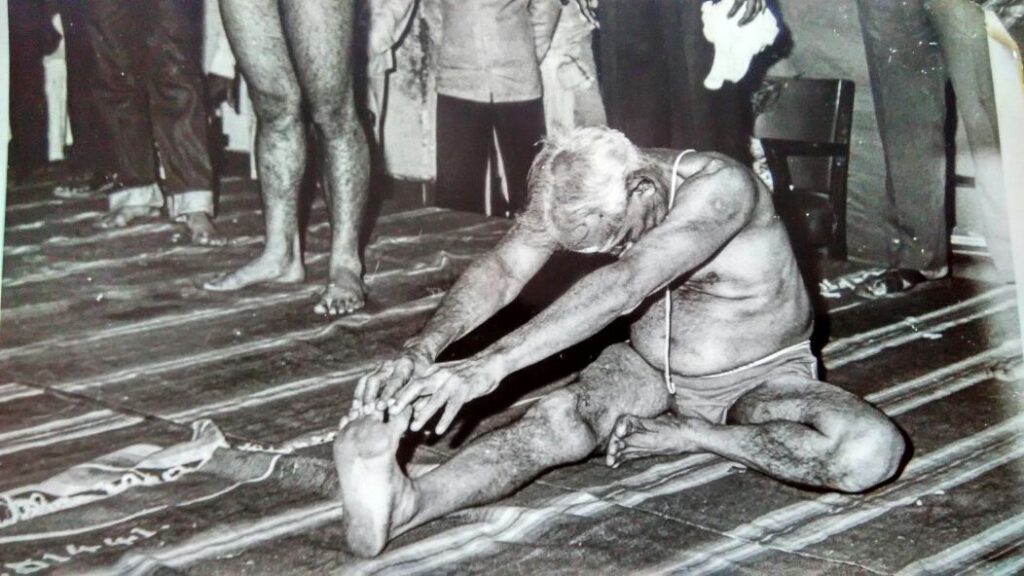
Āsana therefore needs to comply with the following rules;
- Firstly, it should be static, not vigorous or dynamic.
- Secondly, the position should be easy to hold and not stressful.
- There should be minimum movement.
- While, there is no consensus, the Yogacharya Sundaram school recommends a breathing routine.
What is a kriya?
Kriyas are dynamic exercises which increase flexibility of the body. Importantly, sūryanamaskāra and nauli fall under this category.
Banda – this is a holding exercise. In fact, this exercise is far more complex than the above two types and focuses on smooth flow of prāṇa in and around that area of focus. For instance, uḍḍīyana falls into this classification.
What precautions should one take before practicing āsanas ?
- You know your body best. Only push to the limit that your body allows. As soon as there is discomfort, stop.
- Before starting any āsana practice, consult a physician. Practice only to the limits recommended by your physician.
- If you are new to Yogic physical culture, do take the help of a certified master and instructor. The recommendations here are meant to enhance your awareness and knowledge. Ultimately, they cannot and do not replace professional expertise.
Why are Sanskrit words important in describing āsanas ?
There is always a desire to make approximations of the Sanskrit words to make the subject more appealing and less forbidding. However, this takes away from the āsana it’s true meaning. So, that has been avoided in this site. In fact, we attempt to stay as close as possible to the classical aspects of yogāsana.
How important is warm-up before yoga?
Many teachers get started with warm up āsanas and beginner āsanas. However, Yogacharya Sundaram never really did that. In fact, he got people performing the below mentioned āsanas as soon as he could get them to flex. We agree with the approach because, unless the practitioner is invalid or ill, āsanas are not difficult to perform for normal people.
Consequently, we have assumed that most people have normal health and have recommended āsanas which should be practiced regularly for overall health and fitness.
What is the recommended āsana routine for a normal person?
| Sl. No. | Āsana (click on the āsana for detailed procedure) | Meaning / Translation |
| 1 | Padmāsana | Lotus Pose |
| Reverse Bending āsana | ||
| 2 | Bhujaṃgāsana | Cobra Pose |
| 3 | Śalabhāsana | Locust Pose |
| 4 | Dhanurāsana | Bow Pose |
| Forward bending āsana for upper and lower abdomen | ||
| 5 | Pavanamuktāsana | Air relieving pose |
| 6 | Paschimotanāsana | Torso stretch pose |
| 7 | Halāsana | Plough pose |
| 8 | Mayurāsana | Peacock pose |
| Upper region āsana. Focus on neck, shoulders, lungs and head | ||
| 9 | Sarvāngāsana | Pan-body pose |
| 10 | Matsyāsana | Fish pose |
| 11 | Śirasāsana | Head stand |
| 12 | Sundara-viparītakaraṇi | Inverted triangle pose |
| Abdominal āsana | ||
| 13 | Arda-matsyendrāsana | Half fish middle pose |
| 14 | Yoga-mudra | Yoga seal |
| 15 | Uḍḍīyana-bandhā | Abdominal suction |
| 16 | Nauli | Rectus Isolation |
| Standing āsanas | ||
| 17 | Pādahastāsana | Hand to toe pose |
| 18 | Trikonāsana | Triangle pose |
| 19 | Tadasana | Mountain pose |
| 20 | Vīrabhadrāsana | Gracious warrior pose |
| Body reset āsana | ||
| 21 | Śavāsana | Corpse pose |
This should be followed by sūryanamaskāra-kriya.
Internal Links: Dharma (conditioning), Stress and Situational Awareness, Prana, Asana Overview 2, Drishti – Focus or gazing, Pranayama, Hatha Yoga Pradeepika,
External Links: Pancha Tattva, Pancha Prana, Pancha Kosha