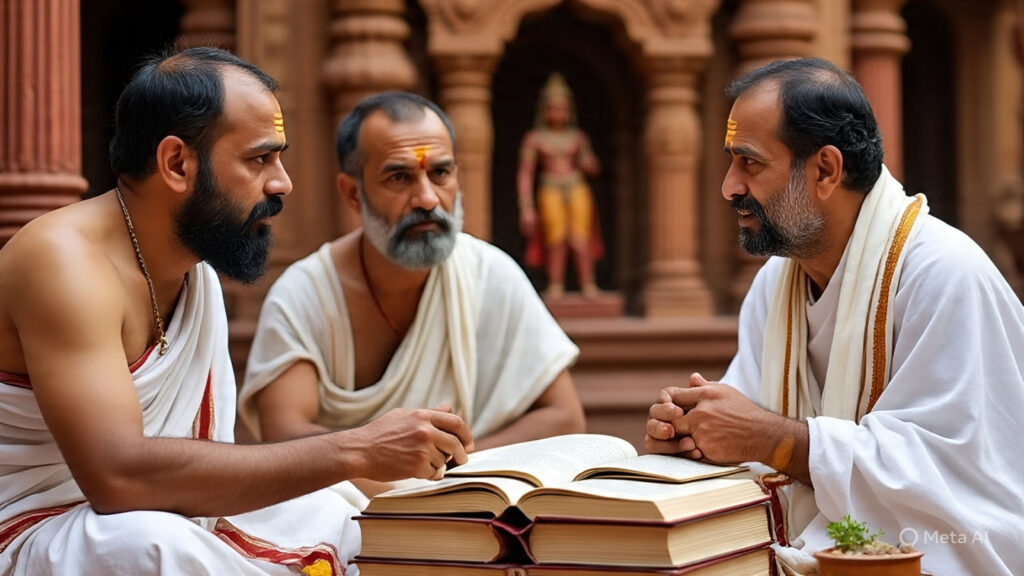
What is pramana?
Pramana (proof of knowledge) are evidence, proof, and hypothesis testing methodologies developed in ancient India. Importantly, this is a testament to the fact that knowledge in ancient Bharat was driven by focus on integrity and truth.
What are the types of pramana in Indian philosophy?
There are six pramana (pramanas). These are – pratyaksha (personal vision or experience of logic), anumana (inference through application of rules of nature), upamana (comparison and analogy with various logical constructs that have been accepted as valid), arthapatti (postulation and derivation from evidence), anupalabdhi (non-apprehension or negative cognitive proof) and shabda (verbal testimony).
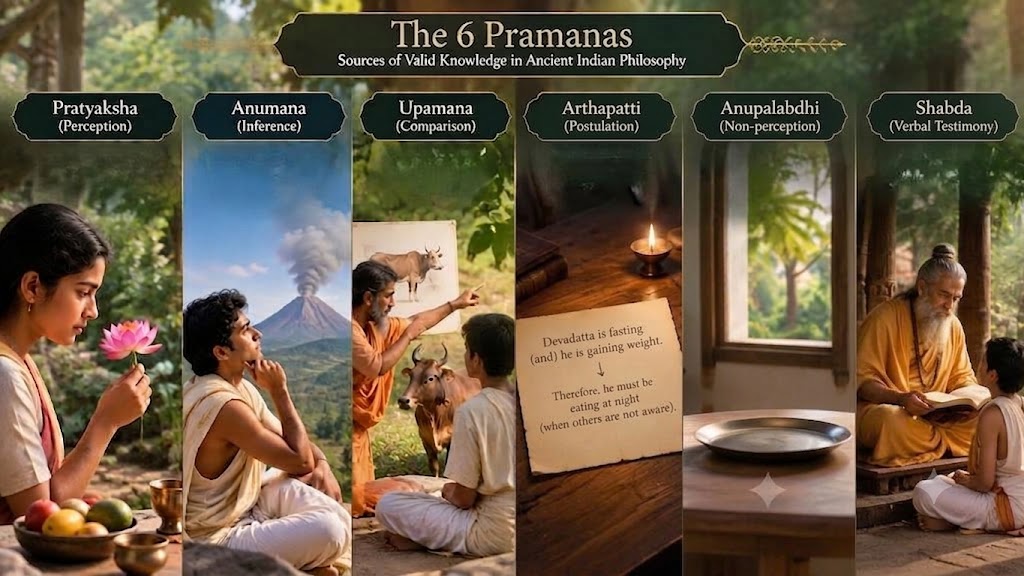
Pratyaksha or personal experience:
Significantly, this is the most effective source of proof because it is based on personal experience.
Example: Firstly, assume that you are walking down a street and spot someone walking unsteadily in front of you. Generally, you would think that he is drunk and feel disgusted. However, as you overtake him, if you were to see that the person is ill or in pain, your attitude would change immediately.
Any change in perception that has been brought about by personal experience in the situation is pratyaksha or personal experience.
Anumana or inference from experience:
This is the drawing of a conclusion based on prior knowledge, say, assuming that if there is smoke, there must be fire.
Example: Assume that you are a parent whose child has been consistently getting good marks and grades. However, if in one exam, the child’s marks were to deteriorate unexpectedly, you would rightly assume from experience that the situation needs investigation. This is anumana or inference drawn from experience.
Upamana or comparison based on experience:
Example: We know that domestic dogs are similar to street dogs because we compare their form and function. Consequently, when we go on a wildlife safari, we are able to recognise wolves, foxes and hyenas as different from dogs.
This ability to compare and conclude is upamana or comparison from experience.
Arthapatti or postulation derived from evidence:
Example: Importantly, all businesses create forecasts based on prior performance and future potential. Furthermore, these projections are based on the analysis of prior performance, examination of current business situation, resources, and risk.
Also, the accuracy of any forecast depends on the analyst’s experience and exposure to various aspects of the business being forecasted.
This is arthapatti or postulation derived from evidence.
Anupalabdhi or negative cognitive proof:
Anupalabdhi is the ability to recognise the missing aspect of any problem being analysed.
Example: Assume that you are collating all your documents for an interview and you find your birth certificate missing.
Since, you recognise the absence of the certificate, you will initiate a search. This is anupalabdhi or negative cognitive proof.
Shabda or verbal testimony:
This is a commonly used type of pramana or proof of existence.
Example: You are a manager with many sales representatives reporting to you. While, you may go with a few on customer visits, you will rely on verbal inputs or shabda of your subordinates to assess the state of your operations.
Conclusion: Importantly, one can see that Bharat’s ancient dharmic system does not prescribe, it allows one to seek, make mistakes, correct in small and incremental steps. This is called anubhava or experience, and enables the practitioner to reach the truth or state of Brahman.
Obviously, to reach the Truth, the aspirant needs to have enormous drive, persistence and patience (shraddha) to overcome frustration and failure.
Additionally, since the path is driven by cognitive proof, the aspirant can choose from multiple paths in a manner that aligns with his or her personality.
Furthermore, when the aspirant is able to do this, he or she is able to transcend illusion, and thus reaches a state of cognitive perfection, the state of Truth or Brahman.
Interestingly, this Truth is enshrined in the Indian constitution as “Truth will triumph” (satyameva-jayate).